

Toy & Miniature Poodles
Merle Poodles
A marbled, watercolor-like coat pattern in Toy and Miniature Poodles — one of the rarer colors we raise, and one we breed carefully, on purpose, health first. Merle breaks up a solid base color into soft, dappled patches of lighter and darker tone, so no two merle Poodles marble exactly alike. Here’s one of the merle puppies we’ve raised, so you can see the pattern for yourself before reading the genetics behind it below.
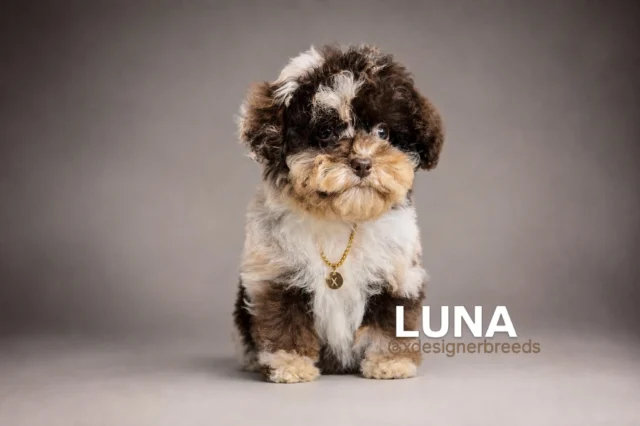
What Is a Merle Poodle?
Merle is a coat pattern, not a color of its own — it lays a marbled, dappled overlay on top of a Poodle’s base color, breaking up solid pigment into patches of lighter and darker tone. It’s an incompletely dominant trait, which means a Poodle either is merle or it isn’t — there’s no hidden “carrier” state the way there is for colors like brown or dilute. A dog with one copy of the merle gene shows the pattern; a dog with none does not.
Merle Colors We Raise
A merle Poodle is named for the base pigment it’s marbling — the pattern is an overlay, not a replacement:
| Black-based | Dilute | |
|---|---|---|
| Black pigment | Black-based Merle | Blue Merle (a true blue merle is always dilute) |
| Brown pigment | Brown-based Merle | Lilac Merle |
Merle can also show up alongside tuxedo, phantom, and abstract markings — a Blue Merle Tuxedo or Brown Merle Phantom is simply that base merle color combined with a white-spotting or point pattern. Some merle Poodles fade or “clear” toward silver as they mature; when that’s likely, we say so plainly rather than inventing a new color name for it.
Where Merle Comes From in Poodles
Merle isn’t part of the traditional Poodle breed standard, and its origin in the breed is genuinely disputed — most evidence points to merle entering Poodle bloodlines through outcrossing at some point rather than occurring naturally within the breed. Individual merle Poodles can still be registered; merle simply isn’t a pattern recognized in the conformation show ring. We’re upfront about this because we’d rather a buyer know the full picture than assume merle is standard. Our founder covers the evidence in detail in Advanced Poodle Genetics, Volume II, including a full look at merle’s disputed origin in the breed. For the deep-dive, our sister site Poodle Genetics Lab has a full article: Merle in Poodles: The Genetics, The Controversy, and What Every Breeder Must Know.
Why We Never Breed Merle to Merle
Pairing two merle parents risks producing a double merle puppy — one with two copies of the merle gene — and double merles carry a real, well-documented risk of deafness and vision problems. In a merle-to-merle pairing, each individual puppy, not just a share of the litter, can have as much as a 25% chance of inheriting two copies. That’s a real, per-puppy risk, not a small fraction we’re comfortable rounding away.
Because of this, we never pair merle to merle. Every merle pairing in our program is planned specifically to avoid producing a double merle puppy — full stop, no exceptions for a “prettier” litter.
Current Merle Availability
Merle shows up in both our Toy and Miniature litters, and occasionally in our available adults. Because availability changes as puppies are reserved, the most accurate place to see who’s currently available — including any current merle puppies — is always our live puppy pages, not a fixed list here:
Want to Be Notified About Merle Litters?
Join our waitlist and let us know you’re interested in merle — we’ll reach out when a merle puppy in your preferred size becomes available.
Want the full genetics behind merle, dilution, and how colors combine? Read our Coat Colors Explained guide, see Advanced Poodle Genetics, Volume II, or try the Advanced Merle Calculator on Poodle Genetics Lab.